State Funeral

Nicholas Jamison

FILM 486

Prof. Kristin Hole

16 March 2020

State Funeral

Sergei Loznitsa’s State Funeral takes the form of a ‘city symphony’ of people in the aftermath of Soviet dictator Josef Stalin’s death.  With no original footage, the film is comprised entirely of archival footage and audio recordings of the massive and ritualistic exercise that was Stalin’s funeral.  Loznitsa deftly molds the footage into a three act structure, with the first act being the announcement of Stalin’s death in all the various Soviet Socialist Republics, the second act being the extended open-casket funeral as Stalin reposed-in-state, and the final act illustrating the conclusion of the ceremonies and formation of a new soviet government.  The first act is a journey through the vast Soviet Union, as people in Minsk, the Altai Republic, and everywhere in between gather in crowds as the radio transmits news of the death.  Cutting between shots of loudspeakers, crowds and individuals, Loznitsa captures the universal shock and despair of Soviet citizens.  The soundscape of the film forefronts baroque yet sterile speeches and eulogies, while a more literal and realistic quasi-diegetic soundscape lurks beneath.  Being comprised of archival footage, the film frequently cuts between color and black and white footage.  As news of Stalin’s death spreads, Loznitsa temporarily moves away from the crowds and focuses on the arrival of emissaries from communist nations intent on paying their respects.  The second act of the film moves into Moscow, where soldiers stand guard as hundreds of thousands of mourners slowly shuffle into the hall where Stalin lies.  This second act is highly repetitive in its use of footage, demonstrating the immensity of the funeral.  As the footage essentially repeats itself, the very minor difference in reactions amongst the individuals captured becomes forefronted as the Soviet Union and the film itself essentially stalls in one moment in time.  Grandiose yet jingoistic and almost cartoonish speeches by various Soviet bureaucrats play over the endless funeral procession as Loznitsa shows footage of Khrushchev, Beria, Malenkov, and Molotov standing solemnly nearby.  The third and final act of State Funeral became thematically muddier then the prior two, and employs several fade-to-blacks that are not seen in the first or second acts.  The third act moves between footage of factory workers standing at attention, to the speeches made by Malenkov, Beria, and others as Stalin is interred, and b-roll footage of memorials in Moscow accompanied by optimistic music.  The editing in the final act feels labored and forced, and the multiple fades to black introduce a new filmic language that struggles to demonstrate meaning relative to the structure of the first and second act.  Interestingly, the film does not provide context for Stalin’s death and shows only the funeral activities — the only political statement in the film is provided via an inter-title disclaimer just before the credits that decries Stalin’s massive pogroms and nationalist tendencies.  Saving this disclaimer until the end of the film and not presenting it at the opening allowed State Funeral to maintain contemplative distance from the subject at hand, whilst simultaneously exploring the subject in great depth.

State Funeral

Dir. Sergei Loznitsa

Lithuania, Netherlands (footage from USSR)

2019

Atlantis

Nicholas Jamison

FILM 486

Prof. Kristin Hole

16 March 2020

Set in 2025, one year after the end of ‘The War’ — presumably the current conflict in eastern Ukraine that further escalates in the near-future — Valentyn Vasyanovych’s film Atlantis follows former soldier Sergiy as he copes with PTSD whilst transitioning back to civilian life.  Sergiy occupies a spartan room in a deserted building nearby a steel factory where he, his friend Ivan, and the majority of the town’s men work.  The factory, like war, is a brutal place to work and filled with harsh metallic clanking sounds and yelling workers.  The town appears to be built around this factory, with one beautiful shot showing a very small Sergiy standing on the roof of his abandoned building with the factory looming over him in a way that appears to be both a telephoto and a wide-angle spherical lens shot — evidently the factory is hundreds of feet tall, allowing a wide-angle lens to function as a quasi-telephoto.  Even with his civilian job at the factory, Sergiy cannot escape the war.  In his free time, he and Ivan shoot humanoid metal targets in the snow that sound reminiscent of the factory when they are shot.  The sound design of Atlantis privileges industrial and metallic noises — the sound of the factory, the sound of gunfire, the sound of trucks in the mud, and the sound of landmines.  Likewise, the cinematography is static and emphasizes neutral and desaturated blacks, whites, greys, and military olive green.  The occasional splash of color is typically the red-white of molten steel, recalling spilt blood.  The combination of sound design and cinematography creates a Kafkaesque world for Sergiy — no matter where he goes the aesthetic of war follows him, even an activity as mundane as taking a bath occurs in the scooper of a backhoe against a desolate landscape.  After the factory shuts down, Sergiy finds himself delivering water via army surplus truck to soldiers and civilians exhuming bodies and landmines from an especially war torn region of eastern Ukraine — even as a civilian in peacetime, Sergiy continues the war effort.  While delivering water Sergiy meets Katya, a woman who is a member of the ‘Black Tulip’ organization tasked with recovering and identifying corpses from the war.  Hoping to atone for his crimes during the war, Sergiy assists her.  In the final act of the film, Sergiy is still haunted by PTSD (Katya likely is as well), yet the sound design of the film shifts away from industrial sounds to include natural sounds of birds and rain.  Through this subtle shift, the film concludes with a sense of redemption for Sergiy and Katya, or at least a sense that redemption does exist.  Bookending the film are infrared night-vision shots that are in a brilliant magenta-red.  The first infrared shot is from an aerial point of view and shows a team of soldiers, including Sergiy, executing and burying a man during the war.  Despite the vivid colors, it feels cold and inhumane.  The final shot is also in the same infrared, but from a more human point of view.  This shot shows Sergiy holding Katya in bed as they (hopefully) move past the war and find happiness.

Atlantis

Dir. Valentyn Vasyanovych

Ukraine

2019

Shorts Block III: The Good and the Ugly

By Sam Schrader

I had the pleasure of seeing the third block of shorts at the 43rd Portland International Film Festival with Charlie Faulker. This was the first screening I attended since the COVID 19 situation really picked up, and the last event PIFF held before cancelling the festival due to concerns of unnecessary exposure (more on this in my impending festival report). This is the only shorts block I was able to attend, but from what I’ve heard from other students in the class, the fact that these films worked well together and (with one glaring exception) were all good in their own ways, seems to be somewhat of an exception this year. Apparently, between technical difficulties, poor programming, and poor film choices, the previous two shorts blocks have been pretty underwhelming.

Of the eight total films, all but one were a triumph. For the most part, the films were experimental to various degrees; shot across various mediums, from high end digital images, to 16mm and archival footage. The variation in formats was fun since the films were split up such that a change in format (often heralded by the curtains beside the screen expanding or contracting to fit a new aspect ratio) would provide a fun interruption in the monotony that can manifest from time to time during an hour and a half of short films, no matter how good they are. 

The real standout film of the night, in terms of excellence, was Emily Vey Duke and Cooper Battersby’s You Were an Amazement on the Day You Were Born (2019, 33mins), from the United States. This film, also the longest in the shorts block by a significant margin, told the story of a woman’s life, from birth to death. Using genuine pathos and brilliant dark humor, the film was able to make the entire auditorium laugh one moment and sniffle the next. Without being judgmental or preachy, the film was able to tell a widely relatable story, made all the more so by a diverse lineup of narrators. Of all the things I was able to see at PIFF before it was cancelled, this is the one for which I am most grateful.

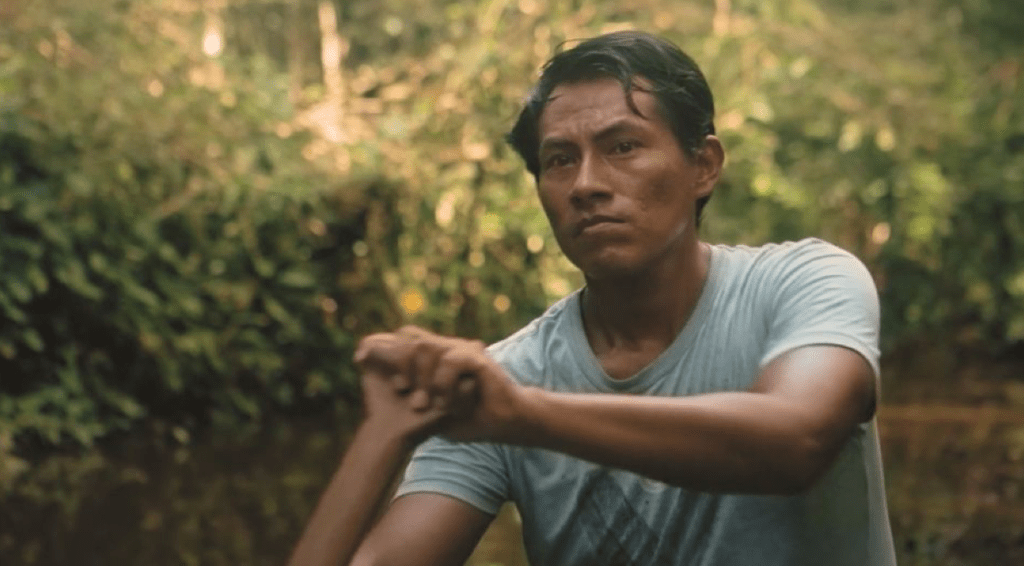
On the opposite end of the spectrum, there was one film, as I’ve hinted at, that really seemed to be punching above its weight. Love Birds (2019, 8mins, Oregon), by Ashely Mosher felt almost like a cringe-comedy Portlandia parody of a “festival film.” It was so out of touch. The documentary begins with a title card linking it, vaguely, to Werner Herzog, and then immediately crushes any hope or excitement that this might conjure in the audience. The film follows, via voice over narration, the emotional journey of the filmmaker as she, sans husband, explores the Amazon River and an emotional affair with a native man named Noe. Noe seems like a remarkable fellow indeed, a skilled painter of wildlife and a man who seems very much in touch with the world around him. Unfortunately, the story of the middle-aged white woman who goes off to a faraway land, fetishizes a native man, and then returns to her comfortable life back home is tired and problematic. This was especially frustrating since the film came after another (much better) film earlier in the same shorts block, which was about empowering and recognizing Native American culture in Canada. I would have hoped that the programmers for the festival would have known better… Ashley was also one of the four filmmakers to do a Q&A after the festival, and when asked by an audience member what her husband thought of the contents of her film, she admitted that the narrative of her romance with Noe was almost entirely made up for effect, essentially admitting to simply fetishizing this man and depicting a false relationship for no other reason than entertainment value. She also took every opportunity to talk about how the film came about as part of a fellowship, or something similar, with Werner Herzog for the purpose of making short docs in the Amazon, and after the third or fourth “Werner told me this,” or “Werner did that,” you could tell that even her fellow filmmakers on the stage with her were growing weary of her name dropping.

All in all, I thoroughly enjoyed my time watching these short films at PIFF. It’s funny, after almost four years in film school, one tends to forget that good short films exist, and I was very glad for the reminder. I am very disappointed that we weren’t able to finish off PIFF strong, due to the pandemic we find ourselves in. However, I feel absolutely confident that this was the right call on the part of those in charge of the closure. Better safe than sorry.

Indecipherable Secrets

By Cornelia Laakso

In a short preface to the Portland International Film Festival screening of The World is Full of Secrets (2019, U.S.), attending director Graham Swon advised that the film has a “strange rhythm,” and suggested that the audience relax and let it get into their bloodstream. The film, which follows five girls at a sleepover trading stories about murder and brutality, is difficult to relax to, in large part by that strange rhythm. Rather than lending itself to the sense of horror and dread which thematically characterize the girls’ stories, the disjunctive pacing of the film informs an overall lack of cohesion and ultimately detracts from its cumulative impact.

A Q&A session with Swon following the film provided useful insight into an objective that was otherwise obscured by the film’s formal structure. Swon noted that the script was inspired by a 1992 crime—some light internet sleuthing revealed this to be the murder of twelve-year-old Shanda Sharer by four teenage girls—the story of which is described in one of the two lengthy monologues in the film. In an effort to tell the story without presenting it as “torture porn,” Swon described the film’s fictionalized and slightly removed structure as offering access to the story without the same violence. This is conducive with the choice to refrain from showing any gore; here, the sense of violence comes from the imaginary realm which is stirred up when the girls tell stories of murder. Tight framing and a concise aspect ratio privilege the girls’ faces as they embark on their monologues; these scenes emerge as an experience of duration which feel divorced from the rest of the film’s pacing and distract from an otherwise rich source material. I found myself wishing that the monologues would end sooner than they did, not because of the content of the stories but because it became hard to see the forest through the trees.

An area of strength in The World is Full of Secrets is in its performances. Swon noted that the two actors who perform long monologues are experienced in theatre, and that much is evident by the sheer amount of dialogue they effectively deliver. Blemishes are purposefully left in these monologues, and at times other lines of dialogue come across as choppy or lacking fluidity. The director described his intention as wanting to reflect the imperfect and awkward ways in which teenagers speak to each other; this sense of realism, much in the tradition of Bo Burnham’s Eighth Grade (2018), is refreshing, but it is also detached from the tight framing, dream-like transposed imagery, long dissolves and crossfades which orient the film outside of straightforward realism. Swon cited an influence in Andy Warhol’s long-take films, such as Face (1966), in which an unbreaking shot follows Edie Sedgwick’s face for an extended amount of time. He described the viewing experience as an evolution; interesting at the beginning, slow and a little boring in the middle, and even more interesting by the end, when seemingly unimportant elements of the shot begin to stand out. Applied to The World is Full of Secrets, this concept falls short; the bigger picture competes with long-shots and ultimately recedes into the lyrical background.

Onward, Future Filmmakers!

By Sam Schrader

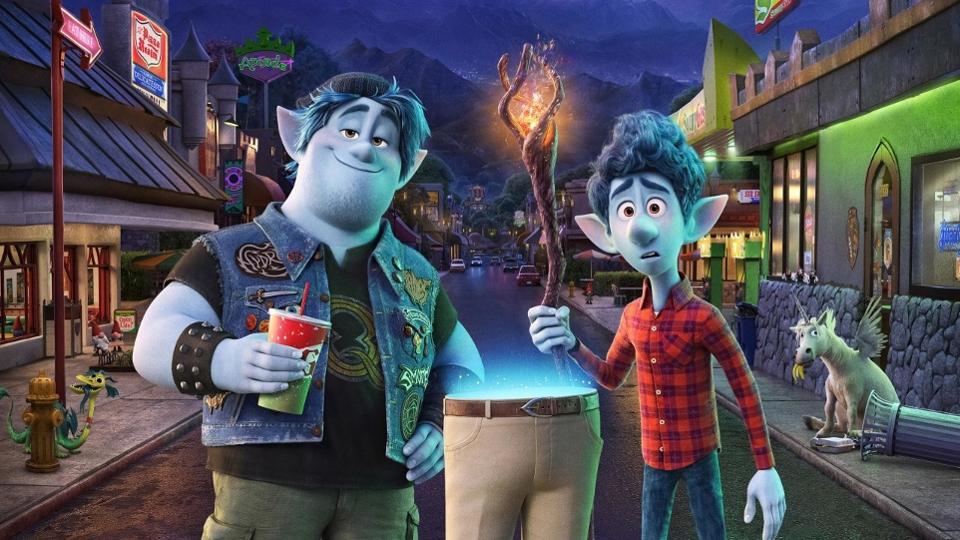
Even before the 43rd Portland International Film Festival, or PIFF (immoderately titled “Cinema Unbound”), began, there was buzz in the community regarding their rather unusual opening weekend selection. There is usually an understanding that one will encounter, at a film festival, what might be considered a “festival film.” This is typically something independent, often international, and dealing with underrepresented subjects — something that would fly under the radar of most casual filmgoers. While the festival did provide audiences with the usual festival fair on the opening night: a collection of indie shorts and features (all from the United States, some from Oregon), the big film of the weekend seemed to be Pixar’s Onward, which was released that same weekend all over the country.

This year, as part of a larger campaign to redesign PIFF, the number of total screenings was reduced, in part to facilitate more events and workshops. This new level of engagement with the film community at large is, in my opinion, a good thing for elevating PIFF to a higher status, despite less programming. However, the choice to give two of their limited programming spots to a film made by the biggest, baddest film production company around (D*sney), which will be seen by millions of people and make millions of dollars, ruffled a few feathers.

As a lifelong Pixar fan, I was torn. On one hand, I think that the complaints leveled at PIFF for this programming choice are entirely valid, they are not supporting Pixar or D*sney in any meaningful way by showing the film at the festival, and they are certainly not supporting the typical, adult festival community by taking up spaces in the limited programming schedule. On the other hand, the way in which they presented the first of the two screenings is admirable. Unlike the majority of the festival fare this year, and the second screening of the film, which happened later the same day, the first screening was billed as a “free community screening” at the Whitsell Auditorium (the Northwest Film Center/Portland Art Museum’s own venue).

By the time the auditorium was full (and it was full), there seemed to be about a 3:1 ratio of kids to adults. While this isn’t a surprise for a new Pixar movie, there seemed to be a real sense of community, more than I would have expected to see at a Regal or something similar. Strangers were engaged in conversation, kids were making new friends, and we all seemed to have the feeling that we were here for more than just a film. Perhaps it was just the labeling of the event as a community screening, but there was a level of camaraderie among us that I don’t usually see at this kind of movie.

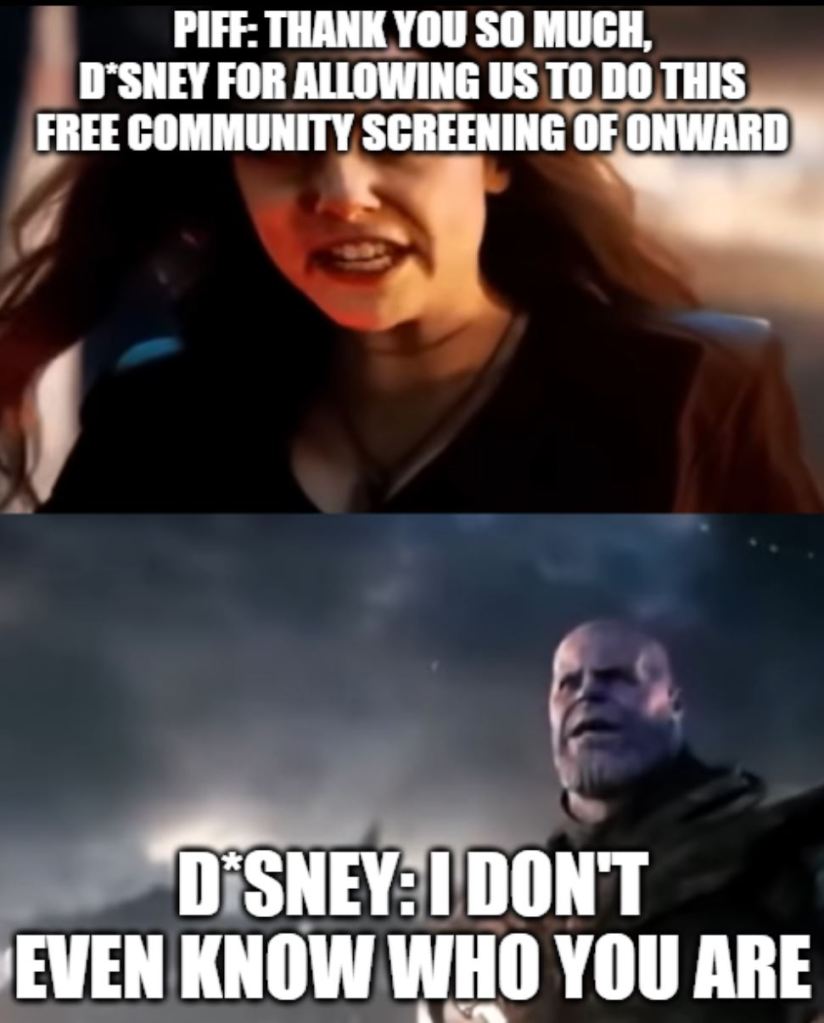
Before the film began, a woman affiliated with PIFF took the stage and gave an introduction in which she thanked D*sney for allowing the festival to put on a free screening of their new film — which struck me as somewhat absurd since they probably couldn’t care less what PIFF does. After this she went on to plug the classes and camps that the Northwest Film Center offers, particularly those aimed at young children. This made me reflect on my own experience as a kid growing up in Portland taking various film related camps and classes, some of them offered by the Northwest Film Center. I didn’t realize it at the time, but these camps and classes had a profound impact on my own career as a filmmaker and scholar. I thought Onward was a really wonderful film too — when it ended I wasn’t sure whether to sequester myself away for a week and cry, or start the best DnD campaign ever written. If the screening and the NWFC can galvanize even one of those kids in the audience to go on and become a filmmaker or film scholar, then I think it was absolutely worth it. The film was totally different than the usual festival fare, but so was the intention.

Where my mind went immediately when the woman was introducing the event…

Shorts Two: Filmic Records, Done Six Ways

By: Cornelia Laakso

The six films in “Chronicles,” the 43rd annual Portland International Film Festival’s second block of shorts, are linked in one common trait; as the title suggests, they can each be described as documenting an occurrence which might otherwise recede into historical or cultural obscurity. The first film in the series, Remembrance (Oregon, 2015) comes from director Sabina Haque and studies the human impact of U.S. drone warfare. Here drone deaths are signaled by tally marks documented in stop motion. Significantly, duration emerges as the key element in this short film; the repetition of a singular action—marking deaths with chalk marks on the walls and floor of a room—instills a sense of magnitude at the sheer volume of it all. As the markings are washed away, they mix with the red powder which before formed the shape of a military drone on the floor; what’s left is a symbolic erasure of lives and deaths in a wash of blood-red. In a Q&A following the film, Haque noted that she makes films for two audiences; Pakistan and the West. The film was inspired by a quote she read from a thirteen-year-old Pakistani boy who now dreads blue skies for the threat they bring of airborne attack. The film provides an effective visual metaphor for both the immensity of human lives lost to U.S. military warfare and the erasure such violence in the West.

Matt McCormick’s The Deepest Hole (Washington, 2020) delves into a lesser-known cold war era race between the U.S. and the Soviet Union, whereby both countries sought to drill as deep as possible into the earth’s crust. The Soviet Union’s “Kola Superdeep Borehole” project was successful, effectively digging the deepest hole in the world. The project took an outlandish turn when audio recorded from within the hole was compared to the sounds of tortured souls in hell; what follows, in McCormick’s film, is a study of global reactions to the notion that the hole had quite literally opened the gates to hell. The film is firmly rooted in reality with its use of archival footage, but collage-style layered visual elements—such as squiggly lines resembling geological layers or sound waves—overlap with archival footage to form a synthesis of real and surreal, a characterization appropriate to the film’s subject itself. At one point in the film the entire screen is consumed with a hypnotic spiral, a not-so-subtle suggestion of humanity’s transfixion with otherworldly answers to worldly questions.

Prabda Yoon’s Transmissions of Unwanted Pasts (Thailand, 2019) follows a satellite engineer who makes a groundbreaking discovery; transmissions received by a satellite she’s tracking might be originating from different decades in the past. Her efforts to expose this discovery—and the vast possibilities it presumes—are thwarted by government figures. The film conveys a sense of unease characteristic of the present moment; here, the powers that be are oppressive, untrustworthy, and operating from an indiscernible position which seems to devalue truth. The film is decidedly on-the-nose in its representation of a government cover-up and silencing of citizens; in a montage of close-up shots, the soldiers, whose role is to muzzle the satellite engineer, cover her eyes and ears, and press her fingers against keyboard keys. A long shot and creeping zoom-out of the woman breaking down in a car after the ordeal underscores a sense of isolation under oppressive forces; against a black backdrop, the car seems to float in a void of ominous silence, the woman inside receding into space. As the title suggest, Yoon’s film is an atmospheric case study which suggests that to reject the past is to also reject the clarity of hindsight which lends itself to a better way forward.

Radu Jude’s The Marshal’s Two Executions (Romania, 2018) depicts two representations of the execution of General Ion Antonescu, authoritarian leader of Romania during World War II. The first version is the silent, black and white footage of the actual execution recorded in 1946, and the second is from a 1994 biographical film directed by Sergiu Nicolaescu. The two versions of the execution are cut back and forth between scenes, underscoring the notion of reality versus reproduction. The chasm between real and representation comes into full focus when the executions take place; static and silent in its black and white time capsule, the original footage is nonetheless striking in affect. Rather than breathing life into the original footage with its use of color and sound, the biographical film is propped up by the intercut sense of weight contributed by footage of the real occurrence.

In We Only Answer Our Land Line (Oregon, 2019), co-directors Woodrow Hunt and Olivia Camfield align the experience of the extraterrestrial alien on earth with the indigenous experience. There is a sense of digital media specificity to the film; at times the screen mimics a computer desktop, digital distortion mixes with static imagery, and collage-style photo cutouts are transposed onto separate imagery. The film does not follow a discernible narrative arc; it is experimental and non-linear, and although—without context—I found it inaccessible in terms of story or message, it comes across as decidedly personal with its use of what appear to be fragments of old family photos. In a Q&A following the program the filmmakers expressed that they are interested in the concept of indigenous peoples as disrupters; those who throw things into disarray, akin to an alien landed on earth. Perhaps reflecting that concept, the film’s digital quilt of disparate elements is disorienting.

Sally Cloninger’s Mix-Mix (Halo Halo) (Washington, 2019) uses the Filipino dish halo-halo as a metaphor for community and self-actualization in the context of womanhood and queerness. Halo-halo is made from a mixture of separate ingredients—whatever is available—to form a cohesive dish of diverse elements. The film itself takes the structure of halo-halo, mixing together footage from three different decades of Cloninger’s life and meditating on her evolution as a queer woman, in—and then out—of the closet. Folded into the mixture are issues of misogyny, feminism, personal narrative and global context. Like the dish of its title, the film combines all of these issues to form a cohesive whole. In one of the more emotionally concise moments of the film, Cloninger places text on the screen against photos of her younger self, reflecting on notions of sexuality and self-denial.  

PIFF 2020: It Must Be Heaven, drawing Palestine through the different worlds.

<It Must Be Heave> (2019) directed by Elia Suleiman

A cynical but heartwarming message for Palestine and for people all around the world.

The opening sequence of It Must Be Heaven has something out of the ordinary. The sacred religious procession is blocked and goes wrong because of the greek orthodox church gatekeeper’s absurd excuse. This opening sequence makes the audience laugh and gives the overall idea of the tone and the philosophy of Elia Suleiman, the director, and actor of It Must Be Heaven. If even the holy religious ceremony has its own issue, is there any place that doesn’t have its own issues? If so, where is heaven? Elia throws this profound question to the audience and himself during the movie. It Must Be Heaven doesn’t have a bombastic narrative but a simple story about his journey from his own village to Paris and NewYork. Most of this film describes his observation of surroundings. His observation conveys his ideas and exploration of the world, human to the audience. However, this movie is not that heavy. It Must Be Heaven is full of the humorous depiction of the world, a thorough analogy of absurdity and poignant sarcasm. 

 Politically and geographically, Palestine is still recognized doubtfully by the world. In 2012, Palestine finally got an observer status by the UN, however, including Israel, USA and most other countries still recognize Palestine as territories inside of Israel, not as an independent nation. For a long time in their history and life, they’ve suffered from continuous conflicts and war with other countries because of the ideological quarrel. As a Palestinian film director, Elia Suleiman has made films about his country for sharing his idea about the identity of Palestine to all around the world, but It Must Be Heaven is not only for Palestine but also for the people all around the world. He remarked at his interview with Cineuropa as“ I think I was just trying to say that the conflict has extended its tentacles to everywhere else around the world and that there’s a global “Palestinianisation” of the state of things. That’s basically what this film is trying to indicate.”. Palestinianisation has lots of different meanings such as war, discrimination, isolation, invasion, economic difference. It Must Be Heaven makes the audience experience the Palestinianisation that happening globally by sharing the experience that he had from three different cities. This film encompasses and expresses all those subjects metaphorically or baldly sometimes. Elia projected stereotypical images of romantic and peaceful Paris or NewYork, He deployed lots of absurdness and sarcastic metaphor in those cities. At Paris, Tanks are roaming around the streets, jets are flying over his head. Police are riding roller-skates or unicycle for capturing criminals. Some medics give fancy food to the homeless. Such dreamlike but looks real things keep going on through his experience in NewYork as well. The cab driver who stopped his car abruptly and praised Elia when he finds out Elia is from Palestine. And at Central Park, police are trying to catch a girl who wears fake angel wings on her back, and put a Palestine flag on her naked chest. The most absurd scene was when Elia picks up some groceries at the store, and he realizes that every single person is carrying a gun casually— even a baby is wrapped with bullets. All those scenes seem not real or just funny, but it makes sense ironically. The audience could understand and have sympathy about those issues because we know there is no ‘Perfect Place’ on earth. Also, he uses overlapping images from three different cities, such as the image of invasion. At his village, some stranger trespassed to his garden every day to take care of Elia’s lemon tree, and when he was at the hotel in Paris, a sparrow disturbs his work. They all don’t have bad intentions in the first place, however, the concept of ‘invasion’ is recognized as malicious action. People are not used to caring about other people’s intention if they are in annoying situation. The foundation of the conflicts that happened throughout the big history of Palestine and other countries is an invasion. Elia suggests the new idea of ‘Invasion’ to the audience as a metaphor. 

 It Must Be Heaven provokes laughter and thoughts about the ideas that Elia offered from beginning to the end. This film has a circulation structure from the start of his hometown, and he left to Paris, NewYork and he finally came back to his hometown again and experience same things that he experienced before he left. But now, the audience could see it differently. The message has a similar structure. Beginning with his criticism about Palestine and his criticism that aims at the world, finally, he goes back to the fundamental question “what is the future of Palestine in this world?” and the audience gets a glimpse of the answer that he received during his journey. He puts “To Palestine” at the end of the movie,  which makes the movie like an invaluable gift. – JK.Lee

Purple Rain: Community Building Through Camp

Film Festivals above all else are meant to bring people together. They are meant to create conversations, create a community, celebrate filmmaking and spectacle. The retrospective on Purple Rain was fun, energetic, and campy. Prince’s film debut celebrated his talent and theatrics and above all brought people together to dance and laugh. This retrospective set out to remind all those attending the Portland International Film Festival what filmmaking and festivals can do, build a community of film lovers. And as our special guest speaker for the night of Purple Rain’s screening: If we want to dance, go ahead, Prince would have wanted us to. 

Purple Rain was screened at the Whitsell Auditorium in the Portland Art Museum, a fact I found humorous. The film has a reputation for being dated and campy, and its presence may have been more welcome at the Hollywood Theater a space that welcomes these types of special screening events more. Art museums are inherently meant to display art pieces, which I must now insist is not to say Purple Rain is not a work of art, however the highbrow thoughtfulness of the space does not complement the campiness of the film. Much like how The Rocky Horror Picture Show is screened weekly at the Clinton Theater in Portland and has created a cult among it, so did Purple Rain deserve such an environment. The sternness of the environment may have been a huge factor in the attendance of the film, the screening was sparsely attended. Again, if it were in a traditional theater, the attendance may had been larger.

The film, despite its now politically incorrect  and misogynistic views on love and domestic violence, succeeds in shining a spotlight on the superstar that was Prince. His charisma translated well on screen giving the effect that we were back in the 80s watching him live. The plot of the film is melodramatic, the acting is awful, and the sides story of the Kid’s turbulent family home was tone deaf to the rest of the film. But in the long scheme of things, who cares? The costumes were zany and of their time, the film was hilarious, and most importantly, Prince was undeniably Prince. The titular performance of “Purple Rain” is still so powerful, now thirty-six years later, that I could not help but be moved by it.

This, to me, is why the current state of COVID-19 and its effect on the city is so upsetting. It is disrupting day to day life and events that bring together the community, such as PIFF. The current state of limbo the festival is on is disappointing though not the fault of the festival itself. Of course, we should be prioritizing our health. Our everyday life will continue and PIFF will return next year. However, it is always important that we remind ourselves what is worth celebrating. That we search for that light at the end of the tunnel. That we celebrate our lives and dance to fun 80s anthems. Prince would have wanted that. 

Written by Anny Gutierrez

The Good, The Impactful and The Problematic: PIFF’s Short Program Number Three

By Charlie Faulkner

You Were An Amazement On The Day You Were Born (2019)

For the PIFF the shorts programming was guided by specified themes; for shorts program number three, the theme was longing. The structure of the night was divided into nine shorts (two of which were not listed on the program for shorts three and came as a bit of a surprise to myself at least) the longest being 33 minutes and the rest averaging at out at about 8 minutes each. Two of the films were located and shot in Pacific Northwest, one being specifically made in Oregon. The range of films underneath this theme I found to be surprisingly wider than expected: documentary, experimental, narrative, and poetic diary film. The stand out piece was You Were An Amazement On the Day You Were Born. The film was responded to very distinctly (and vocally) throughout the audience. Large bursts of laughter and sentimental sniffles filled the auditorium of The Whitsell. Profoundly vulnerable, courageous, powerful visuals and absolutely, wildly hilarious, Emily Vey Duke & Cooper Battersby’s work was one of passion and it really shone through. The film creates a prolific and detailed memoir of a life from beginning to death juxtaposed by nature and wildlife, emphasizing the cruel and hilarious circle of life that exists within our world as we understand it. Though it tackles intense topics of mental illness, suicide, and dangerously manipulative men, the film is overwhelmingly charming and the voices of Duke and Battersby is as unique as it is profound. The loud echos of a T-Pain song playing as a precursor to a discussion of a suicidal ideation, recreations of a letter received from a professor ,whose dog the narrator fed Plan B to, in a feeble attempt to fix her mistake of letting the dog in questio go to the dog park while in heat despite his strict instructions, and animations of the narrators secret power to scare away creepy men in bars with a hideous smile are just a small portion of moments that erupted the audience in laughter (to the point of tears for some).

There were many other excellent shorts, the documentary films both being tremendously engaging and a major focus of intrigue. Century Farm focused on the simple and monotonous living of the filmmakers uncle who manages the family farm that has remained within that family for one whole century. The gentle and personal touch that comes from the filmmaker’s close relationship to the subject material felt deeply apparent and certainly added its impact. The film was relatively quiet, lacking a consistent voice over or talking head the film allowed the audience to be immersed in the tranquility and repetitions of farm living. The uncle whose focus of the film was an elderly man who clearly carried a great deal of pride and care in all that he does. Filmmaker Stephanie Hough during the Q+A following the screening revealed her development in adapting the short into a feature length piece. 

The second documentary, Fast Horse made by Alexandra Lazarowich, follows what is referred to in the film as “America’s First Extreme Sport.” The film follows a group of indigenous individuals of The Blackfoot descent on a team that actively engage in the competitive sport of bareback horse riding relay race. The team’s newest jockey is as determined as he is eager. The passion and dedication the tribe has to the tradition is clearly and beautifully portrayed by the film. The film begins with the introduction to the sport and various detailings of the training process, and the film finally crescendos with an intense racing competition in which the newest jockey is participating in for the first time. He suffers a brutal and dangerous hit in the race but miraculously manages to continue the race, all things considered, fairly well. The film does an eloquent job in rooting the context of the sport in the importance of the event to the indigenous folk who carry on the legacy and tradition of the practice.

Love Birds (2019)

While many of the films illustrated longing in similarly profound and diverse ways, there was one film that left a bit of discomfort and scrutiny, from myself and some other folks that I had the opportunity to discuss with at the end of the screening, was the film Love Birds  directed by Ashley Mosher. A triumph of beautiful and mesmerizing cinematography, unfortunately missed the mark in its problematic narrative. The film follows the story of a privileged white woman primarily based on many truths (with the occasional fictitious weaving) of the director feeling sick of life in the city and becoming compelled to pack away her life and travel to adventure and enlightenment in the Amazon jungle. On her journey she meets a Peruveian local of the jungle who she forges a fixation upon that feels rather exploitative. It is not an uncommon narrative of the privileged white woman fulfilling a very self indulgent enlightenment on behalf of the spectatorship of the“unconventional” beauty in the simplicities of native lives and other various cultures. This phenomena which can largely be viewed under the obsession of such narratives like Eat, Pray, Love is often guised under a less-overt neo-liberal and neo-colonialist ideology. This inappropriate and exploitative journey to self is often praised as bold and inspiring, especially to white audiences. The privilege of profiting of the stories of traditions and heritages of other cultures and ways of life should be viewed critically. It was unfortunate to see such a narrative unfold in the PIFF lineup, as I was deeply moved by the rest of the shorts within the program. 

Thunderbolt in Mine Eye: Coming of Age in the “Me Too” Era

by Karlee Boon

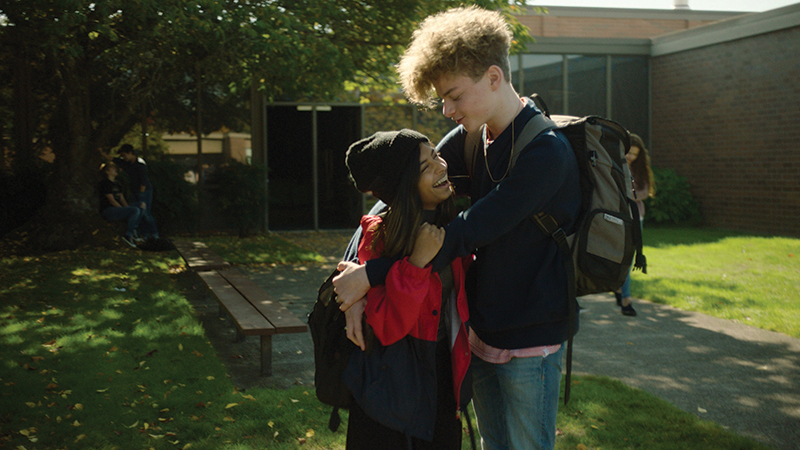
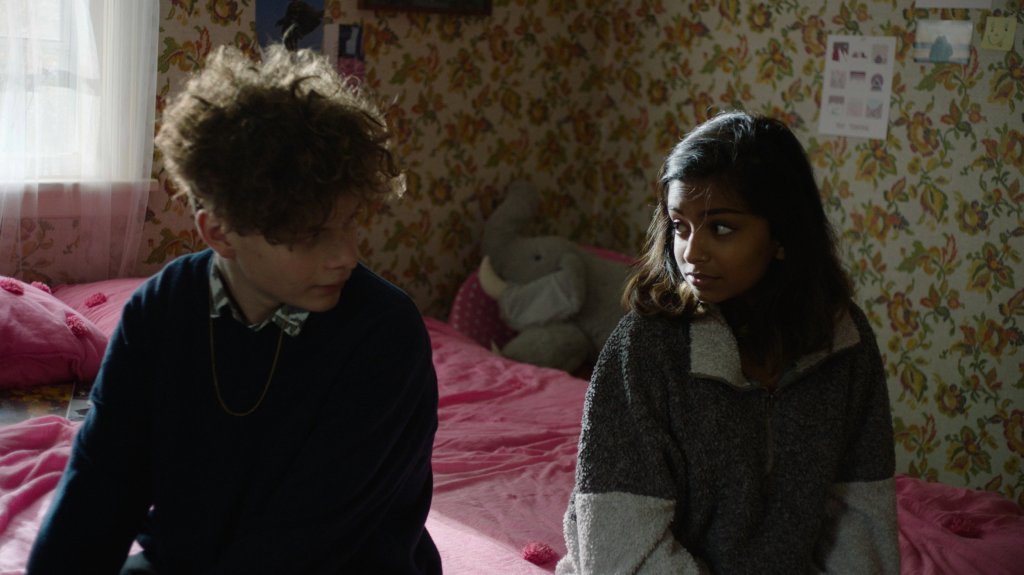
Thunderbolt in Mine Eye is a local feature film directed by Portland-local brother/sister directing duo Sarah and Zachary Sherman. The film had its World Premiere on Tuesday, March 10 at the Whitsell Auditorium, with both directors and the lead actress all in attendance. The film follows Harper (Anjini Taneja Azhar) as she enters her freshman year of high school, experiencing her first relationship and sexual awakening along the way. When Harper begins a romantic relationship with her brother’s best friend and across-the-street neighbor Tilly (Quinn Liebling), she is forced to face the gender stereotypes and double standards that come with being a sexually active girl in high school. 

The two lead actors, Anjini and Quinn,  have incredible chemistry on-screen, and it was a joy to watch their relationship transform from a series of exhaustingly awkward exchanges to a genuine and honest romance throughout the course of the film. Thunderbolt’s portrayal of high school, as a whole, felt more accurate than in many other depictions of teenagers in film and television. Later during the Q&A, directors Sarah and Zachary stated that it was incredibly important to them that the film felt genuine to the modern high school experience, something I felt was definitely achieved through the mis-en-scene, costuming and casting. Despite the accuracy in the film’s portrayal of the high school experience, however, I did feel that Thunderbolt lacked in originality as far as the plot and overall presentation. Nothing about the character arcs or the film’s conflict felt new or exciting, and the many allusions to women’s rights, the “me too” movement and gender politics felt heavy-handed and abrupt within the film’s context. Overall, while Thunderbolt in Mine Eye excelled at creating the atmosphere and tone of a genuine and awkward high school experience, it lacked in the originality and stylistic presentation to make it stand out from the slew of other modern coming-of-age films.

Following the film, both directors Sarah and Zachary Sherman and actress Anjini Taneja Azhar were invited to the stage for a Q&A facilitated by fellow local filmmaker Tara Johnson-Medinger. Being familiar with Tara’s own directorial works like My Summer as a Goth, another locally-made coming-of-age feature, I think she was a perfect fit as the facilitator for this particular film. During the Q&A, the directors discussed their casting process, which included sourcing quite a few of their actors including Quinn Liebling (Tilly) from the local Netflix original series Everything Sucks!, which filmed back in 2018. They also went into some detail regarding their crowdfunding campaign, which they held through Seed&Spark, and how that eventually led to them having the film produced by the Duplass brothers. Seeing a pair of young filmmakers navigate independently funding their own features and how successful they’ve been throughout the process really gave me hope for my own future in the film industry within Portland. A large majority of the crowd that attended Thunderbolt’s premiere were involved in the film in some way, whether it having been through a financial contirbution, being background actors, or offering up their homes as filming locations. Thunderbolt felt undeniably “Portland,” from the subject matter, to the stunning locales, to the community effort it took simply to get the project off the ground. It’s a shame that this film didn’t get a second chance to screen at PIFF this year but I feel positive about its future reception within the City of Roses and beyond.

Design a site like this with WordPress.com
Get started