By Hannah Cumming
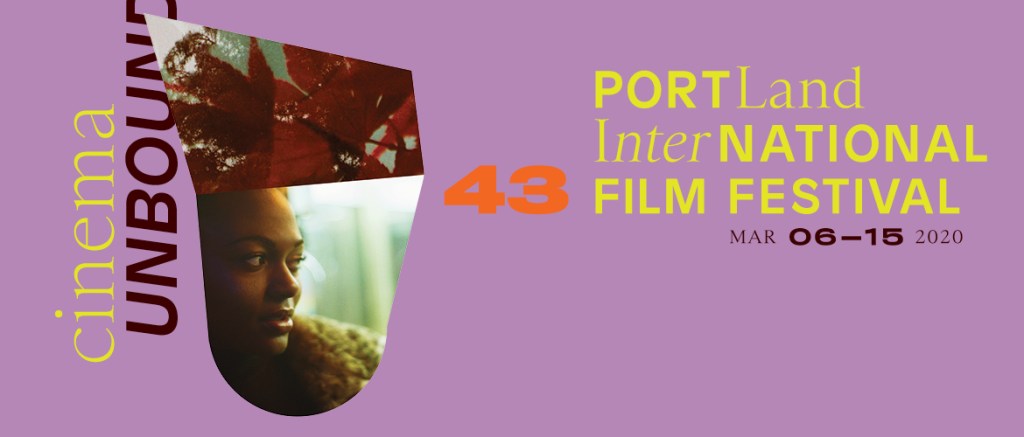
The 43rd annual Portland International Film Festival (PIFF) was experiencing a rebranding this year, before it’s unfortunate cancellation on day seven of the festival in an effort to reduce the COVID-19 spread. After hiring a new director, Amy Dotson, the NW Film Center decided to combine the previously separate and regionally centered NW Filmmakers Festival (NWFC) with PIFF in order to incorporate more PNW talent and showcase both international and local films. This was a big year for the festival, as it was testing out a lot of new changes in structure, programming, and exhibition. The festival had more workshops, panels, and networking events than ever before – another effort to further intertwine the festival with the Portland film industry. In addition to this new model, the festival had a variety of immersive multimedia experiences such as the seven hour live listening party of John Cameron Mitchell’s podcast (of which he was in attendance), and the large art installations (the Mobile Projection Unit) projected onto the side of the Portland Art Museum that accompanied opening night and the after party. These multiple efforts to diversify the film festival experience did exactly what they were meant to, “the festival harnesses the time of contingency through live events that bookend screenings, introducing into the offering the singularity of an experience that cannot be reproduced at a later date or location” (Harbord, 76). By providing audience members with the ability to interact with the films, filmmakers, other festival goers, and other forms of multimedia art, the festival was distinguished from both its previous years and other competing international festivals. The NWFC’s goal for this year was to solidify the festival’s position in the global film sphere, aspiring “to the status of a global event, both through the implementation of their programming strategies and through the establishment of an international reach and reputation” (Stringer, 139). By also incorporating a wide variety of local works, the festival uplifts their local industry to a more global scale as well, “Their ambition is to use the existing big festivals as models so as to bring the world to the city in question, while simultaneously spreading the reputation of the city in question around the world.” (Stringer, 139).
In addition to including more regional films, this year the international programming portion seemed to incorporate many independent foreign films with underrepresented narratives (not including the Pixar film Onward). The program reads, “PIFF strives to act as a platform for underrepresented voices and serves as a catalyst for cultural appreciation, conservation, collaboration, and community building.” This can be seen in their selection of films from a wide variety of countries, cultures, and filmmakers. By elevating the voices of those who may not always have the outreach required to promote their work globally, the festival betters the film’s chances of securing a distribution deal, “Festival screenings determine which movies are distributed in distinct cultural arenas, and hence which movies critics and academics are likely to gain access to.” (Stringer, 134) Not only does a film festival screening increase the opportunity for international distribution, but they also provide more underrepresented films with a prestigious stamp of approval – the clout to take home to their national cinema, “While sales, foreign distribution deals, and the interest of talent agents are some of the hoped-for outcomes of festival exposure, those films and directors regularly represented in festivals are also likely to garner something else — critical capital.” (Czach, 82)
In addition to the incredible international films that were selected, I was particularly interested in the locally produced films (both short and feature length) that were scheduled to screen at this year’s festival, such as: Thunderbolt in Mine Eye, Sophie Jones, Clementine, First Cow, Borrufa, Frank and Zed, and more. Unfortunately, due to the fear of COVID-19 spread that led to the festival’s cancellation, I was only able to see the screening of Thunderbolt in Mine Eye, a debut feature by brother-sister directing duo Sarah and Zachary Sherman. After the screening, the directors and their lead actress (also local) took to the stage to partake in a Q&A facilitated by local producer/director/and POWfilm fest founder Tara Johnson-Medinger. Sarah was able to answer many of my questions regarding their success with the crowdfunding platform Seed and Spark, as well as inquiries about directing with her sibling, what it was like to make a coming-of-age story with actual teenagers, and her personal experience of filming in her hometown of Portland, OR. The ability to speak to local or international filmmakers directly is not something one can experience at any theater or on the comfort of their own couch – and that immersive exhibition experience alone is enough to go back year after year. But it was the new additions to the festival experience (emulating those of Cannes, Tribeca, Sundance, and more) that really solidified the success of their short but eventful 43rd year, “Cannes and other major international film festivals are about advancing the cinematic art and international collaboration, not so much among the film-producing nations nowadays but rather among the film industry professionals who come from many different corners of the world” (Ostrowska, 30). PIFF took the initiative to make this year’s festival an incredible networking opportunity for filmmakers who were traveling from out of town, as well as filmmakers who were right at home. In an effort to advance the Portland film industry through interactive panels, networking events, and workshops led by local industry professionals, the festival also intertwined their programming of regional films with the international films seamlessly, as if to deliberately put them on the same level, “the work of programming became not about selecting the films, but arranging them into programs that would enable unexpected connections” (Rastegar 189). There were no “Portland Made” shorts blocks or screenings that were overtly marketed as “local.” By showcasing both international voices and local voices, the 43rd annual Portland International Film Festival managed to uplift the local industry to a global scale while simultaneously providing audiences with a diverse assortment of work by filmmakers from all over the world.
Works Cited
Czach, Liz. “Film Festivals, Programming, and the Building of a National Cinema.” The Moving Image, vol. 4, no. 1, 2004.
Harbord, Janet. “Contingency, time and event: an archaeological approach to the film festival.” Film Festivals: History, Theory, Method, Practice, edited by Marijke de Valck, Brendan Kredell and Skadi Loist, Routledge, 2016.
Rastegar, Roya. “Seeing Differently: The curatorial potential of film festival programming.” Film Festivals: History, Theory, Method, Practice, Taylor & Francis Group.
Stringer, Julian. “Global Cities and International Film Festival Economy.” Cinema and the city: film and urban societies in a global context, edited by Mark Shiel and Tony Fitzmaurice, Blackwell, 2001.
 PSU School of Film @ PIFF