Written by Garrett Recker
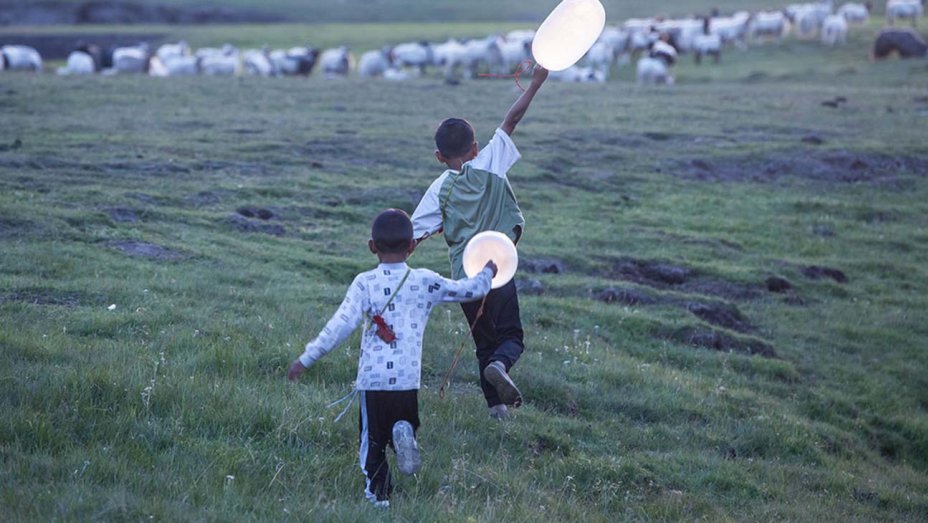
Balloon is a 2019 Chinese drama, written and directed by Pema Tseden, that explores how religious and political barriers control free will from a Tibetan perspective. The opening of the film sets the overall tone by explaining China’s One-Child Policy in dark red text. Families that give birth more than once must pay a high cost child tax if they choose to keep the child. Already, political barriers are at play. If the family is impoverished, as is the one depicted in Balloon, then their will to grow is entirely dependent on income. The mother’s free will is also hampered by political rulers telling her how her body should operate. Tseden’s opening shot critiques this, depicting Dargye, the father figure of the family, talking to his elderly dad through an inflated condom Dargye’s boys thought was a balloon. The boy’s presence dominates the scene with the condom influencing the visuals and their laughter sounding closest to the audience. However, the two boys themselves aren’t seen. The idea of two boys is a paternal longing made impossible through a political barrier, represented here by thin latex. This critical scene depicts how sexual contraception, and previously stated political policies, censor the family dynamic. It isn’t until the “balloon” comes down that the boys may enter the frame.
Pema Tseden’s Balloon doesn’t follow a traditional narrative with a sole protagonist and their journey. Instead, all the family members share the spotlight, each having their own arc and subplot with the theme of “free will” acting as the common thread. The use of lateral lines to divide the frames are prevalently used throughout the film to highlight the elements that prevent the use of free will. When Dargye goes to his brother to buy a male sheep, a large wooden beam splits the frame in half between both characters. Despite their family tie, the divided frame keeps their economic difference, and the meaning for Dargye’s visit, at the forefront of the scene. They are positioned not as loving brothers but as a shopper and merchant engaged in a transaction. Dargye’s free will is never depicted because of his economic status causes isolation.
The mother, Drolkar, is also continuously void of her free will. After learning from a monk that her fourth unexpected pregnancy will be the reincarnation of Dargye’s late father, Drolkar is ridiculed by her family for wanting an abortion. Initially, she had willed her husband to use condoms when making love, but her request was met with contempt. Her husband, and other men in the village, view the use of such modern inventions as perverse and shameful. Due to cultural belief in the form of peer pressure, she reluctantly gives up her free will. The family’s low economic status, however, continues to push Drolkar towards an abortion. A fourth child tax would cause starvation for everyone in the family. While outside cleaning the house rugs, Dargye makes a final plea for her to keep the baby. At first they share the frame but as it becomes clear that neither will change their stance, they become divided by the hanging rugs. Just as before, the frame is spliced into two halves highlighting the presence of free will. One of them must once again set their free will by the wayside and abide by the wishes of the other.
Pema Tseden’s focus on free will, or the lack thereof, crafts a seemingly authentic depiction of an impoverished Tibetan family. The religious and economic regulations of the upper class constrict those of lower status to the point where they lose all autonomy. The characters presented in Balloon aren’t doing what they want but instead what is expected.
 PSU School of Film @ PIFF