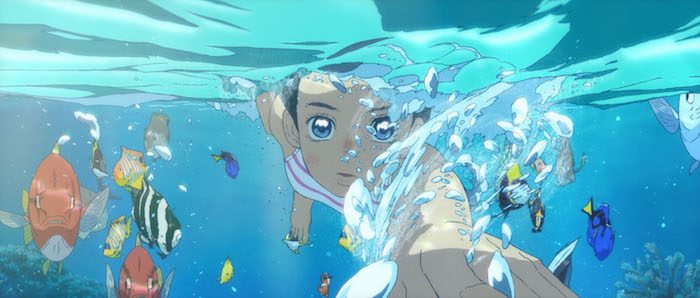
A Japanese animated film from 2019, Children of the Sea is a story mixed with a fantastical visual experience. The showing at the festival was sponsored by the Consulate Office of Japan in Portland, and a short survey was handed out to fill after the film. One of the questions asked if the viewer’s opinions of Japan had changed after watching the film, and whether the change was negative or positive. Another asked if the viewer had a better understanding of Japanese culture after viewing the film. This is an interesting approach to assessing the value of an international film showing. The film did not explicitly discuss Japanese culture in a way that someone would necessarily gain a better understanding. The culture in the film did not appear any different from the culture of any American seaside city. Perhaps the similarities overwhelm the differences, and this may be the intention of the Consulate.
The film is centered around a young girl, Ruka, as she is sucked into a world operating unseen within our own. This is a very common premise, especially in films for children or young adults. There also seems to be a love triangle at play between two brothers. The love triangle in particular is rather unsettling given the implied youth(early teens, likely) of those involved, though their exact ages are never explicitly revealed. There is also a strangeness in the vast difference of their appearance, the younger being dark skinned with dark hair and the older being pale as a ghost with long blond hair. It is almost as if the filmmaker is pitting one appearance over the other, and Ruka seems to prefer the pale, older brother romantically while maintaining a more protective relationship with the dark, younger brother.
The alcoholic mother was underdeveloped, and her place in the story seemed only as a catalyst to push Ruka into certain situations, like her visit to the aquarium as opposed to going home because her mother was there. It is an odd choice to have her mother’s self-destructiveness not play a bigger role in her life outside of Ruka’s avoidance of her. It is never really faced until the end when the father symbolically removes the bag of empty beer cans from the entrance of their home. This is where the differences between Japanese culture and American culture seem quite different. An American film would have played more into the alcoholic mother and her place in Ruka’s life, while Children of the Sea seems to wave her off as only minorly important. In the end, Ruka’s bond with her mother is strengthened by her memory of a lullaby. In a post-credit scene, the family welcomes a new baby, where Ruka asks her mother where she learned the melody. The focus on the lullaby and it’s connection to the events of the film throughout also seems to be a cultural disconnect. The film tried its best to explain the legends, but it feels as though pieces are missing that do not allow an American audience a true understanding of the film and all of it’s meanings.
Beauty was an element that all audiences could understand. Interspersed in the story are segments of interstellar art. On several occasions, the film looks to the sky through the stars, often combining these images with others for a “multi media” aesthetic in the representation of a mystical world outside of our understanding. Nearly constant flashes of this art style in Ruka’s mind hold us in a fantasy place, facilitating the suspension of disbelief for all of the oddities throughout the plotline. All of these increasingly elaborated sequences of visual artistry lead up to a fantastical display as the film comes to it’s climax. For a few minutes, the film is less of a film and more a visual display of color and movement all surrounding the interstellar themes of the previous displays.
The end message the film leaves with the viewers is that we are children of the stars, or we belong to the stars, something along those lines. It is not the first film to center around such an idea, but it was an enjoyable rendition of the concept. Visually it was quite stunning, and the pacing of the plot keeps a viewer interested throughout. At the same time, it was somewhat lackluster in terms of narrative and the element of confusion with the very young love triangle and other things that are never really explained. It felt as though the film was trying to do too much. There were too many underdeveloped characters with little to no significance in the film, too many sub-plots and themes that the film touched on but never really explored. This left the film as a whole with a sort of “half-baked” feeling, even with its nearly 2 hour run time. It was overall an enjoyable watch, though how memorable the film is is questionable.
- Emma Mayfield
- 818 words
 PSU School of Film @ PIFF